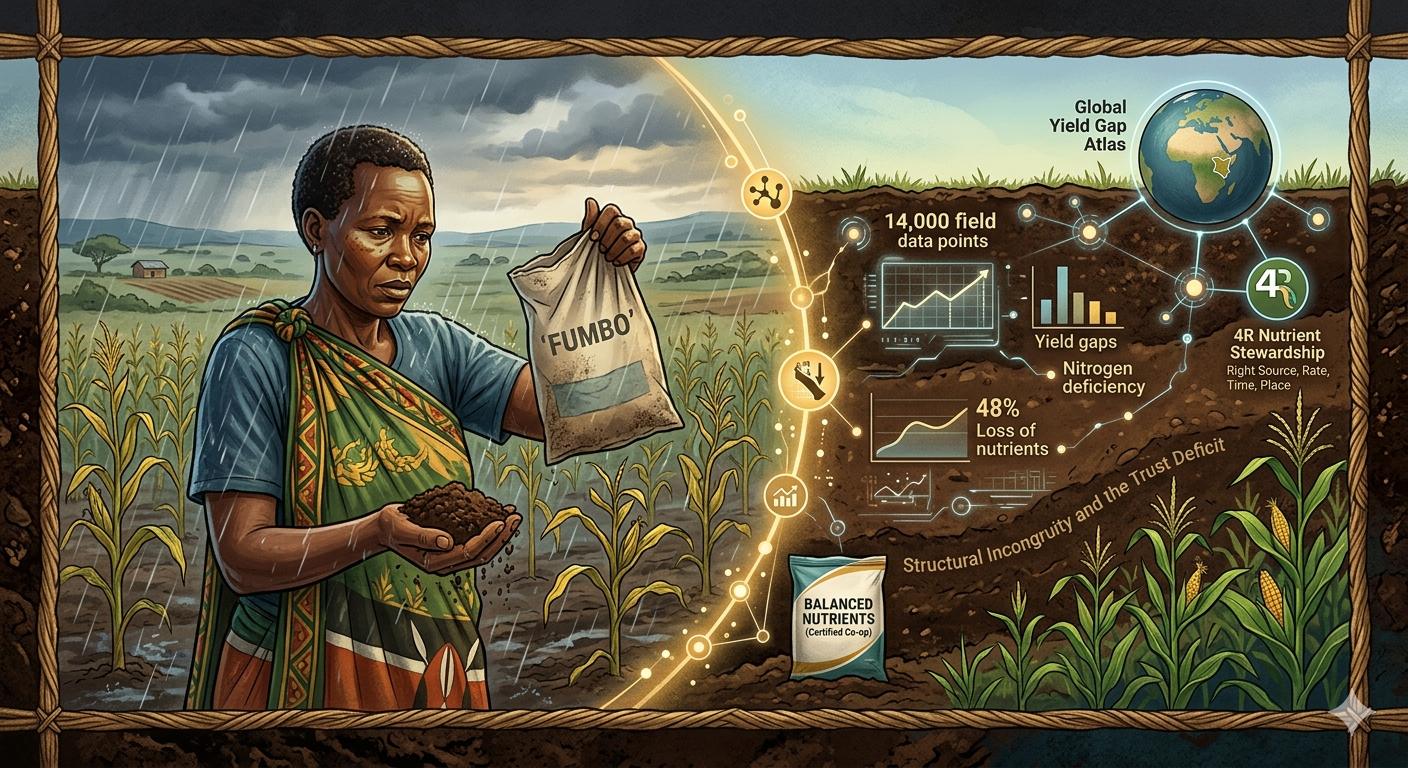
BIALBADI, KENYA — From the edge of her two-acre maize plot in western Kenya, Miriam Omwamba monitors the encroaching cloud cover signaling the arrival of the long rains. She holds a handful of reddish-brown earth—soil that looks fertile to the casual observer but represents a highly precarious, recurring economic gamble for her household.
For decades, international development narratives have maintained a strict, singular focus on African agriculture: the continent’s soils are depleted, and the primary remedy is simply to supply and apply more commercial fertilizer.
However, systemic multi-year agronomic data tracking across the continent paints a far more complex picture. Ongoing empirical analyses of over 14,000 smallholder fields across Sub-Saharan Africa demonstrate that while nitrogen deficiencies consistently explain 48 percent of the regional maize yield gap, the bottleneck to rectifying this is not a lack of chemical science. It is a chronic, structural failure characterized by acute labor bottlenecks, macroeconomic import shocks, and market fraud.
"We face an incredible, concurrent environmental tax on our production," explains Dr. Shamie Zingore, Director of Research and Development at the African Plant Nutrition Institute. "The continent loses over US $4 billion worth of soil nutrients each year, severely eroding its baseline food sovereignty. With more than 60 percent of agricultural land in Sub-Saharan Africa currently facing severe, ongoing degradation, crops lack the balanced nutritional foundations required to achieve baseline genetic potential."
The Anatomy of a "Fumbo"
The local dealers call it the fumbo—the mystery bag.
Each season, on the outskirts of Kakamega, smallholders like Emmanuel Were confront this systemic failure at the market gate. Last year, Were invested 7,500 Kenyan shillings, nearly a third of his seasonal savings, into a 50-kilogram sack of diammonium phosphate fertilizer. The bag bore the crisp, heat-sealed logo of a registered multinational distributor.
But when Were slit the polypropylene weave at sunrise, the contents inside lacked the characteristic uniform, gray-black granular sheen of genuine fertilizer. Instead, it was a coarse, chalky mix of crushed limestone and low-grade river silt, dyed with charcoal water.
Emmanuel applied it anyway, trapped in the desperate optimism familiar to many smallholders. Within six weeks, his maize crop stalled, the leaves yellowing from nitrogen starvation before the stalks could reach waist-height.
This is the unpriced reality of sub-Saharan agriculture: a landscape where soil nutrition is not merely a matter of chemical application, but a high-stakes, recurring lottery.
The Flawed View from Above
The multi-thousand field data sets tracking this crisis are part of a broader agronomic movement pushing back against detached, top-down global development models. Historically, international institutions evaluated agricultural yield potential through macroeconomic models calculated in offices thousands of miles away from the target fields.
"Foresight about food security and associated agricultural research priorities based on top-down approaches are subject to a high degree of uncertainty," says Dr. Patricio Grassini, Professor of Agronomy at the University of Nebraska-Lincoln and co-leader of the Global Yield Gap and Water Productivity Atlas.
Grassini champions a rigorous, data-driven bottom-up spatial scaling approach that rejects abstract regional assumptions in favor of local weather station metrics, specific soil properties, and directly supplied farmer data.
"This is a call to set the record straight regarding global yield gap benchmarks," Grassini notes. "If we are going to use this information to inform policy and our investments, we better make sure that the information is sound and has been validated on the ground."
Without anchoring agricultural investment profiles in the specific biophysical and socioeconomic environments where production takes place, global interventions end up treating localized symptoms rather than root structural failures. Long-term data shows that current average farm yields consistently languish at a mere 20 percent to 42 percent of their true attainable biophysical potential under ideal, localized management.
The Macroeconomic Catalyst
While international policy focuses heavily on farm-level behavior, it frequently omits the macroeconomic catalyst driving this counterfeit trade: the foreign exchange trap.
Sub-Saharan Africa relies on imports for over 70 percent of its commercial fertilizer supply. Local currency depreciation against the US dollar across major regional economies—including Kenya, Nigeria, and Ghana—triggers massive, recurring localized price spikes for imported inputs.
When legitimate, imported inputs double in price, governments are forced by fiscal constraints to roll back blanket subsidy programs. This price cliff pushes desperate smallholders out of formal, secure supply chains and into the unregulated open market, where high prices create an incredibly lucrative margin for counterfeiters. Input fraud is not an isolated criminal issue; it is a concurrent economic symptom of import dependence and macroeconomic volatility.
This variance explains why, nearly two decades after the African Union’s historic 2006 Abuja Fertilizer Summit—where participating nations committed to raising fertilizer application rates to at least 50 kg per hectare annually—the continent remains far below its own benchmarks. FAO data indicates that average fertilizer consumption across Sub-Saharan Africa has only managed to crawl to 22.6 kg per hectare. This stands in stark, sober contrast to a global average of 116.4 kg per hectare, or Asia’s baseline of 186 kg per hectare.
The Labor-Nutrient Paradox
In elite policy forums, the consensus solution centers on Integrated Soil Fertility Management delivered via the 4R Nutrient Stewardship framework: the Right Source, Right Rate, Right Time, and Right Place. Yet, translating this macro-level science into field-level execution exposes a profound, recurring operational disconnect.
To execute the Right Place and Right Time mandates, a farmer cannot simply broadcast fertilizer into the wind. The protocol requires labor-intensive subsurface spot-placement next to individual seeds, followed by a secondary split-application precisely synchronized with crop demand and local rainfall patterns.
For female-headed smallholder households, this creates an unviable labor trade-off. When peak rainfall arrives, available hours must be split between planting, immediate weed suppression, and domestic labor. When physical time is structurally constrained, precision nutrient management is inevitably sacrificed for baseline farm survival.
"What we are trying to solve is a severe scaling disconnect," notes Dr. Imane Slimani, Soil Fertility Specialist with the UN FAO's Land and Water Division and a contributor to the International Network on Soil Fertility and Fertilizers. "Agronomists possess exceptional macro-level data. However, we lack the agile, localized frameworks required to connect top-down crop decisions with tangible logistical realities on the ground. We cannot treat soil health as an isolated biophysical experiment; it is deeply bound to human time budgets and smallholder logistics."
The Communal Biomass Friction
The structural friction extends beyond individual plot boundaries into localized resource governance. Integrated Soil Fertility Management protocols dictate that commercial inputs must be integrated with organic resources, primarily by retaining crop residues on the field post-harvest to rebuild the soil's organic carbon stocks.
However, across many rural African communities, traditional land-tenure systems dictate that harvested fields revert to open-access, communal grazing land during the dry season.
A farmer who attempts to retain crop residue to regenerate their soil profile directly collides with communal grazing customs. Fencing off a plot to preserve biomass creates intense social friction, while leaving it unprotected results in its immediate consumption by communal livestock. Soil health, therefore, ceases to be an individual agronomic choice; it is a complex, unresolved challenge of community asset governance.
Rewriting the Blueprint
If sub-Saharan yield gaps are to be closed, green infrastructure models must pivot away from pure soil chemistry toward systemic de-risking. Driven by demographic growth, sub-Saharan maize demand is projected to increase 2.3 times over the next 30 years. Over the last two decades, this has resulted in a horizontal crop area expansion of 17 million hectares into fragile natural ecosystems, a structural pattern that is ecologically unsustainable.
"We must turn data into actionable decisions," Dr. Zingore emphasizes. "Effective nutrient stewardship supports sustainable crop productivity improvements, directly mitigating the pressure to expand agricultural frontiers into fragile ecosystems. But we must transition from monitoring soil degradation to actively managing the concurrent socio-economic conditions that cause it."
For Dr. Slimani and international agricultural networks, this means reshaping regional supply chains and structural frameworks. "Our target is to advance circular bioeconomy models and tailored fertilizer innovations that eliminate the logistical guesswork for smallholders, making balanced soil nutrition a structural default rather than an unattainable operational burden."
Back on her plot in Bialbadi, Miriam Omwamba opens a certified bag of nitrogen sourced from a newly regulated, cooperative input hub. Her decision to invest is driven by a marginal increase in structural trust. The broader battle for African food security will not be won by discovering new scientific breakthroughs; the chemical data is definitive. The definitive victory will belong to those who build an agricultural infrastructure that values a farmer’s time, cushions them against macroeconomic exchange shocks, and protects their wallet from fraud.