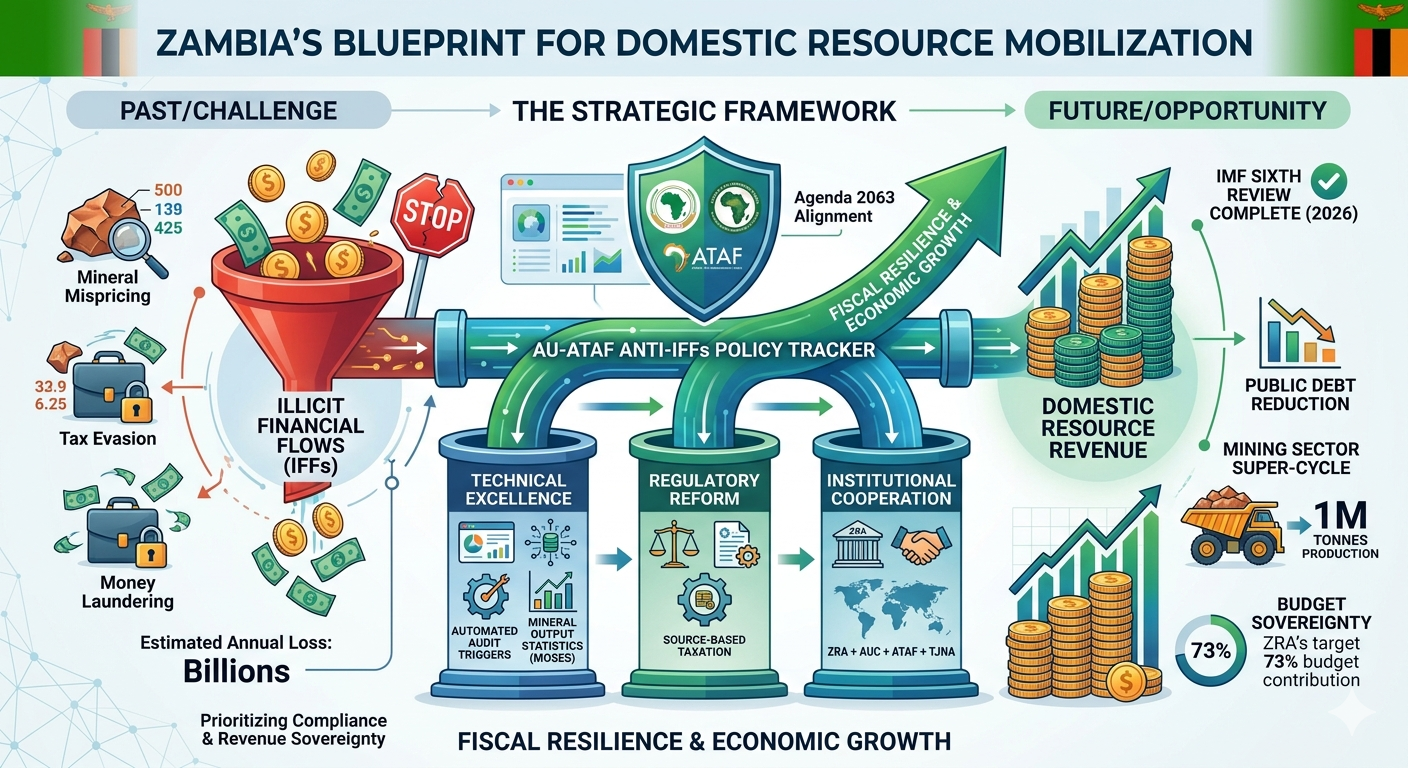
LUSAKA — For the logistics manager of a mid-sized copper-wire plant on the outskirts of Lusaka, the "red flag" didn’t come as a knock on the door, but as a digital alert. A shipment of specialised resin from a European supplier had been flagged by the Zambia Revenue Authority’s (ZRA) new automated system. In the past, this might have been a week-long paperwork headache; today, under the newly launched Anti-Illicit Financial Flows (IFFs) Policy Tracker, it is a high-stakes audit trigger.
The Macro Stakes: Anchoring a Post-Debt Recovery
While the launch in Zambia is a fresh milestone, it arrives at a critical juncture for the continent’s most-watched recovery story. Following the successful completion of the IMF’s Sixth Review in January 2026, Zambia has corrected significant macroeconomic imbalances. With public debt dropping toward a projected 93.4% of GDP, the government is under immense pressure to maintain fiscal discipline as principal repayments on restructured debt commence.
The Anti-IFFs Policy Tracker is the technical engine of this discipline. Dr. Patrick Ndzana Olomo, Head of Economic Policy at the African Union Commission (AUC), argues that the success of this rollout is a litmus test for the continent’s ability to self-regulate. "Zambia’s assessment is timely and aligned with continental priorities," Olomo noted, emphasizing that the tracker is a core pillar of Agenda 2063, shifting the focus from foreign aid to domestic revenue sovereignty.
The Billion-Tonne Stress Test
The stakes are heightened by a booming mining sector, set to produce a record 1 million tonnes of copper in 2026. This "copper renaissance" has forced a technical overhaul of mineral oversight. The ZRA is now using this surge as a stress test for its Mineral Output Statistical Evaluation System (MOSES), a platform that ensures by-products—often "bundled" and exported without separate invoicing—are captured for fiscal purposes.
ZRA Commissioner General Mr. Dingani Banda strikes a tone of deliberate, authoritative optimism. He views the tracker as an "African-grown solution" that professionalises the tax environment. Banda’s sentiment is one of collaborative reform: moving from a posture of "catching" tax evaders to one of "partnering" with compliant businesses. His goal is to push the ZRA's contribution to the national budget to 73% by the end of 2026.
Operational Intelligence: Global Standards, Local Enforcement
This shift aligns with a broader global movement toward source-based taxation in Africa. Mr. Thulani Shongwe, ATAF’s Head of African Multilateral Cooperation, points to landmark cases like Mopani Mining as proof that "strong institutions and technical expertise deliver tangible results."
For manufacturers, this "Intelligence Dividend" removes the "discretionary" nature of audits. Ms. Chenai Mukumba, Executive Director of Tax Justice Network Africa (TJNA), highlights that reclaiming these resources—estimated at $88.6 billion annually across Africa—is the only way to fund the infrastructure businesses need to thrive. Proactive firms can turn this into a competitive advantage by:
- HS Code Alignment: Eliminating "misclassification" flags through precise data matching with global partners.
- Unbundled Costing: Separating freight and insurance to clear automated filters without human intervention.
- Transfer Pricing Certainty: Using LME-aligned benchmarks to justify transactions upfront, avoiding retroactive penalties.
The New Bottom Line
As Zambia narrows its fiscal deficit to a projected 2.1% by 2026, transparency has evolved from a CSR metric into a core requirement for market leadership. The winners in the 2026 commodity super-cycle won't just be the firms with the best products, but those with the cleanest data. As the ZRA’s automated eyes get sharper, the distance between a successful shipment and a priority audit is now measured in the accuracy of a single digital code.